
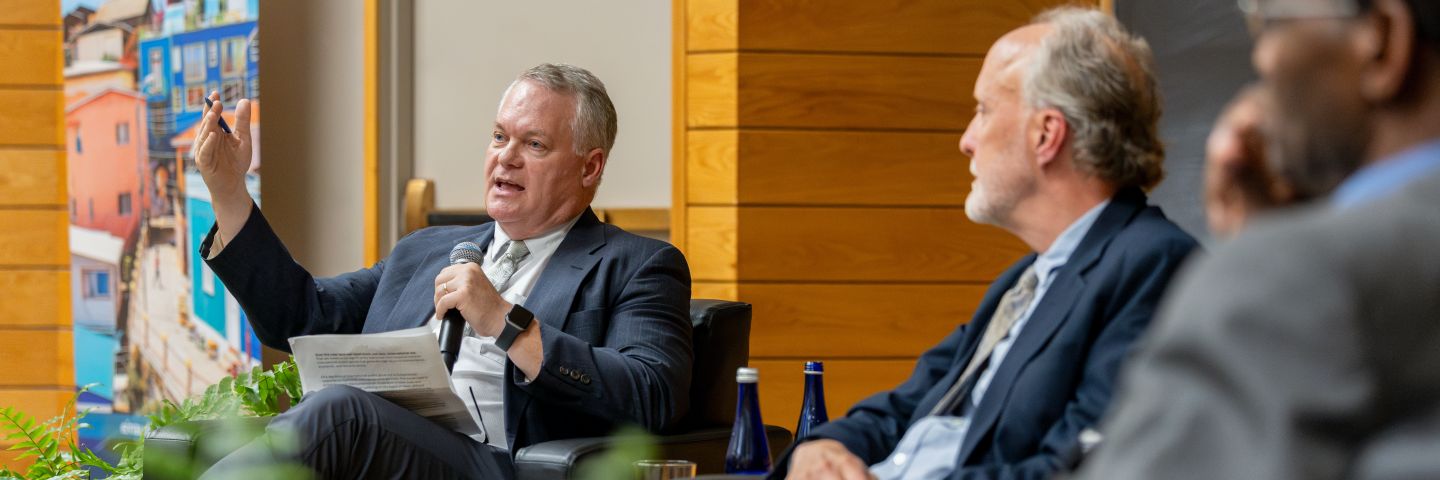
Five Students Receive Migrations Creative Competition Awards
Two undergraduates and three graduate students have received Migrations creative writing and art competition awards. The annual competition asks: How does migration shape life in your community? Their work tells the story of migration across different communities—what it is like to leave home, to build a new one, to visit a borderland, and to experience change.
The Kindness of Strangers
By Yinka Adetu
PhD Student, Literatures in English, College of Arts and Sciences
I
James Baldwin, it was, who wrote about his experience of being the first black man in a village whose inhabitants had never seen a colored before. He wrote with a certain conviction that being the stranger in a strange land expanded his consciousness and mode of being in the world. “I am a stranger here, but I’m not a stranger in America,” Baldwin lamented in a long essay, “Stranger in the Village,” that documents and complicates the strange familiarity he experienced in Leukerbad, a remote Swiss village some four hours away from Milan. It was this movement that the Nigerian American writer Teju Cole traced in his essay, “Black Body,” which appeared in his collection Known and Strange Things, to experience the village Baldwin wrote about and published in 1953. It was in 2014 that Cole, in a posthumous honorific attempt to experience and place Baldwin’s journey to this remote village, traveled to Leuk and documented his encounters similar to Baldwin’s, within a conundrum of experiences that converge and diverge differently. The idea of strangeness, the mode through which the concept of “being strange” sits in the thoughts and consciousness of these two figures I revered, challenged me when it dawned on me that I’d travelled to Ithaca for postgraduate education.
February 7th 2025. It was 11 p.m. Nigerian time when I received the congratulatory email from Katrina Overton, the coordinator of the PhD program in the Department of Literatures in English, and it was not the first time I had interacted with her. I remembered months prior, after submitting my application, my references were not received the day before the deadline. She had emailed to notify me of it, so I had to update my referees so my application would be considered and sent to the graduate admissions committee. The night I received the congratulatory offer, I thought about how Katrina, with her diligence, had made it possible to stand a chance and emerge among eight candidates from a pool of hundreds of applicants. This was what brought me, for the first time in my life, out of Nigeria, out of Africa, and to Ithaca. It was the kindness and diligence of a stranger.
“There were a few glances at the hotel when I was checking in,” Cole wrote about how divergent his experience was from that of Baldwin, since after Baldwin, the village had seen more coloreds, and a few were living and working there. Outside of Africa, in Europe and even in India, Cole writes, “there are glances.” “The test is how long the glances last, whether they become stares, with what intent they occur, whether they contain any degree of hostility or mockery…” In a similar vein, Baldwin also wrote about the astonishment of being perceived as a “wonder,” and how the culture of the village “controlled” him.
While surfing the internet for news about Nigerians who had visited Cornell, I stumbled upon a Cornell Chronicle article about Chinua Achebe, visiting in 2005, meeting a group of students who won a Things Fall Apart essay contest. I had digested the content and highlighted Achebe, saying he was filled with “profound gratitude and surprise,” and this was also my feeling when I read another congratulatory email from Lindsay Thomas, the Director of Graduate Studies in the department. Achebe, I think, was very humbled when he said, “I wasn’t highly educated, in terms of knowing about human nature and the ways of the world,” but emphasized that his book had gone “places” he could not follow, as it did in Ithaca.
II
What strange familiarity draws me to Baldwin and Cole, and the story they shared about the stares of inhospitality from those who considered them strange? It is not just because I have learned a great deal from these two proven intellectuals, but also because I have been reflecting on my journey to Ithaca through the efforts of people I was unfamiliar with, and through the kindness of strangers that I never expected. Kindness, like the feeling of strangeness, is inherently a human quality. But in Baldwin’s and Cole’s accounts in this remote village, it was almost impossible to find a hospitable recounting of any “kind” experience from a villager. They were both subjects of whimsical glances and stares. Baldwin lamented in his essay that the villagers regarded him, “not only as a stranger in their village but as a suspect latecomer, bearing no credentials, to everything they have—however unconsciously—inherited.”
Before I landed at the John F. Kennedy airport in New York, America had always been a construct in my imagination. I was a young kid when our school texts incorporated the experiences of Nigerians who returned from countries like England and the United States. I remember that strange feeling when I learnt about the four seasons in elementary school, but I struggled to understand because they were foreign concepts. The snow, in my imagination, then, was heavenly punishment and rain of ice.
I knew, without knowing, as a young kid, of the pristine, ever-shining White House, New York City, and even the Statue of Liberty, which James Baldwin had, in an interview, called “a very bitter joke.” All these experiences failed and displaced my imagination when I moved to the U.S.
Away from home, in unfamiliar territories, the migrant remembers the kindness and inhospitality of strangers. And both experiences are profoundly shaping. Even though we are all strangers, at first to ourselves, then to the people we identify and familiarize ourselves with, and choose to love, it is uncertain whether there is sanctuary outside the home, in defamiliarized spaces. Yet, to meet kindness in the eyes of strangers and find a place of belonging outside “home” is refreshing.
III
It is hopes and dreams that sometimes pull us away from home as we strive to grow and become more responsible individuals in the world. But dreams alone are not enough to live as strangers in new places. There are days—this being one of them—that I remember many people have passed through graduate school, took classes in one of the many halls at Goldwin Smith, to earn a degree, gain experience, or find a job. I recall, for example, Professor Biodun Jeyifo, who worked in the department for many years, wrote and developed critical insights into African literary studies, and recently passed away. I was very young, beginning my university education in literary studies, when I started reading his works, many of which were written during his time at Cornell while he was teaching African and African American Literature. It is a mix of the worst and the best feelings to know for certain that your dreams—since you were young and dreamed of becoming a professor in African literary scholarship—are now beginning to feel within reach.
Yet, like with Baldwin and Cole, it is unsettling to voyage to a new place in search of a part of the self: the envisioned future self. Baldwin was searching for solitude and self-reclamation; Teju Cole was honoring this memory at a time when the reality of life was similarly connected to Baldwin’s, and here I am chasing dreams in Ithaca at a precarious time. The hardest part of being exiled is coming to terms with displacement and even learning to adapt to the unfamiliarity of a new environment. I still find the snow unattractive; it reminds me of my marginality. And my life is interwoven within a conundrum of harsh migratory realities. I am an exile with almost no freedom, subjected to controlled and regulatory behaviors, and I must relentlessly develop myself and realise my dreams in a country where I do not belong. In this predicament, even when I don’t expect it, I always choose to remember the kindness of strangers.
Where Lines Are Drawn
By Ariela Asllani ’26
Public Policy, Jeb E. Brooks School of Public Policy
All photographs were professionally captured by Asllani during the summer of 2025, a month spent along the U.S.–Mexico border in southern Arizona. The work was produced while volunteering with Tucson-based humanitarian and advocacy organizations, including Tucson Samaritans, Humane Borders, and No More Deaths.
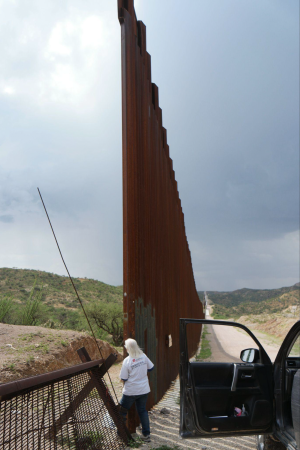
Arizona, U.S.-Mexico Border. Humanitarian patrol with Tucson Samaritans, providing water and aid in migrant corridors and identifying movement to deliver lifesaving supplies.
Steel introduced itself as necessity / not interruption
The desert did not consent / the statute did
Vertical lines rehearsing division / pretending permanence
We learned where to stand / where not to cross
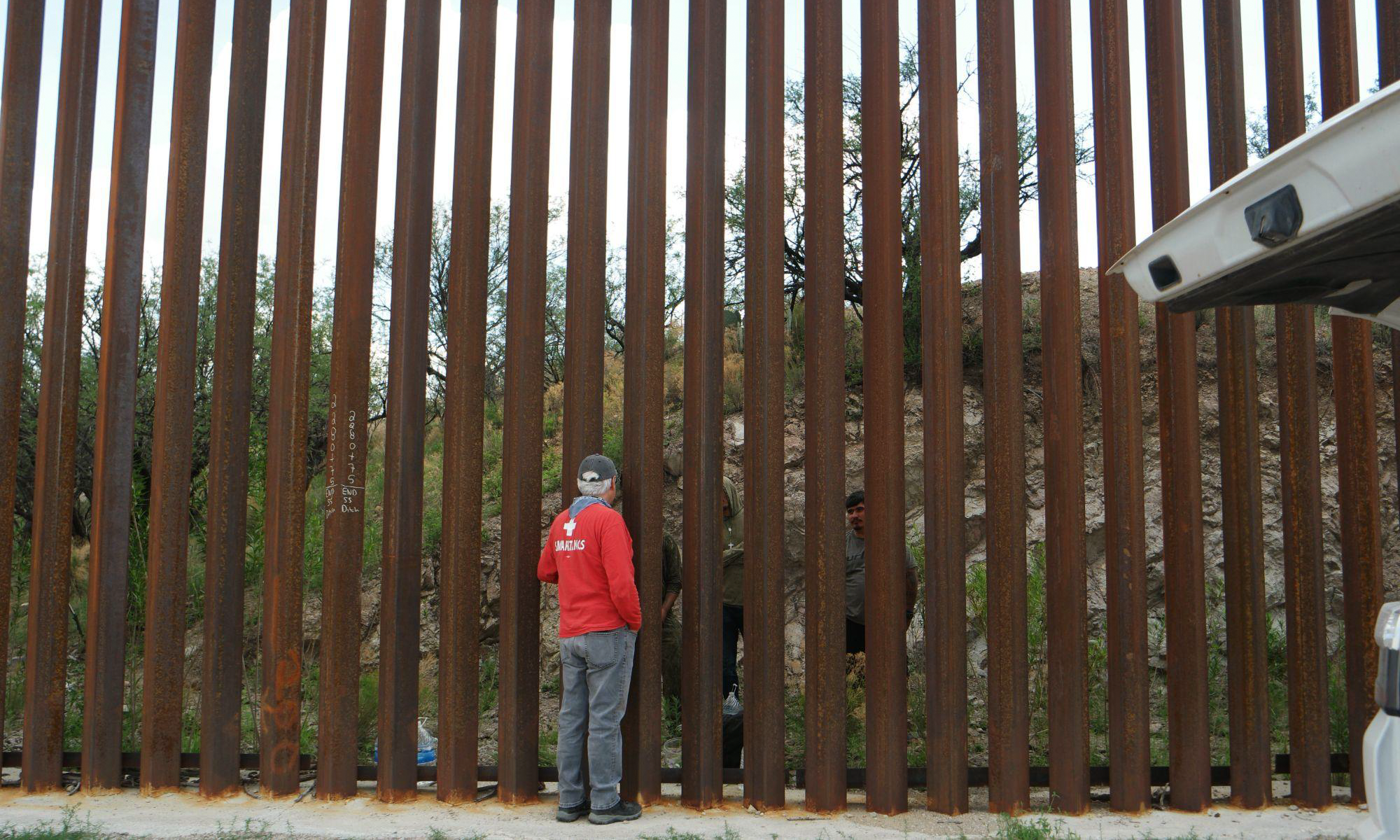
Faces align briefly/hands do not
Voices travel through rusted intervals/bodies do not
Aid passed carefully/conversation stopped by steel
We speak across an architecture/designed to end speaking
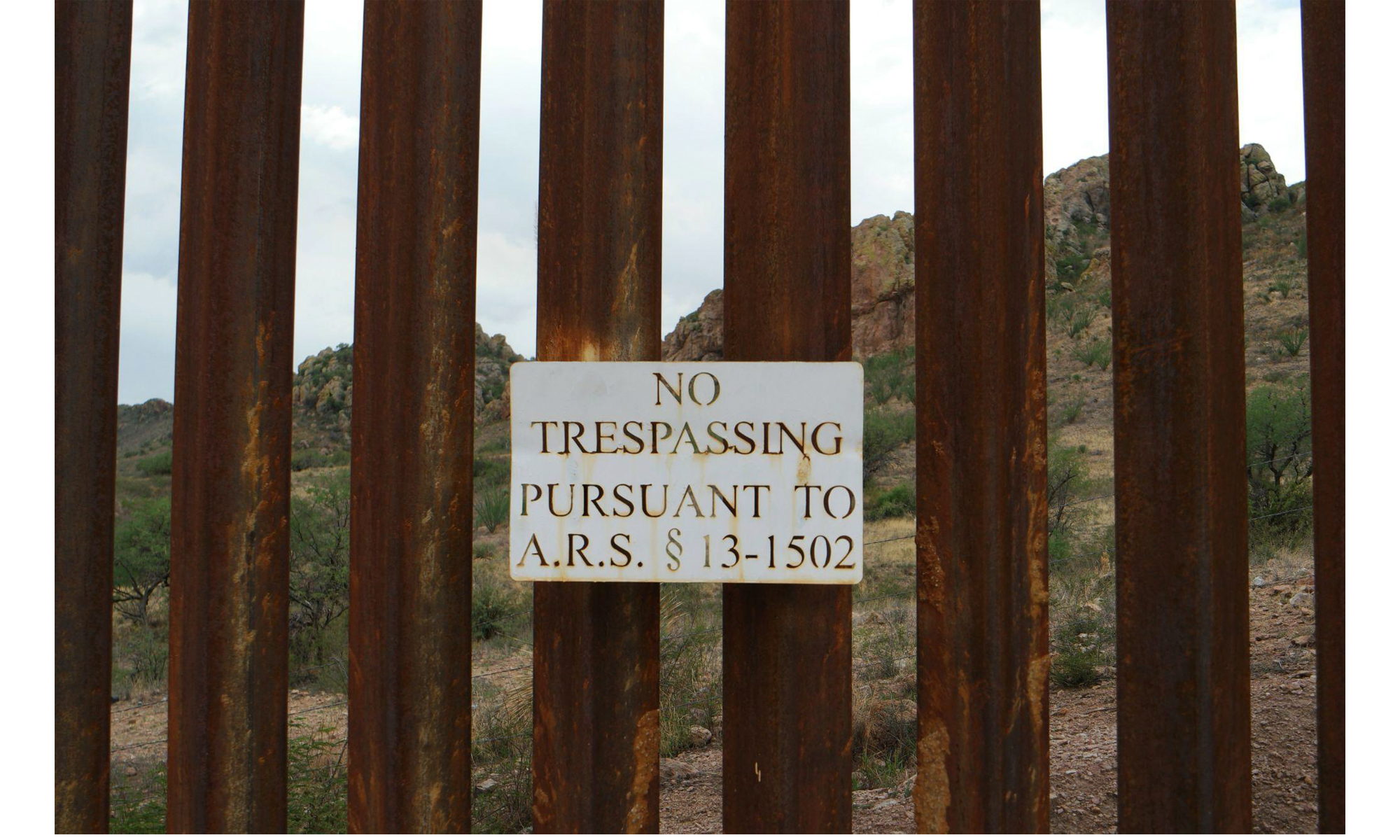
The sign speaks first/before anyone moves
Entry redefined as violation/presence as intent
The desert now reads/like a citation
Sásabe, Sonora, Mexico. Once a border town, now largely abandoned as cartel violence and territorial control have emptied the community.
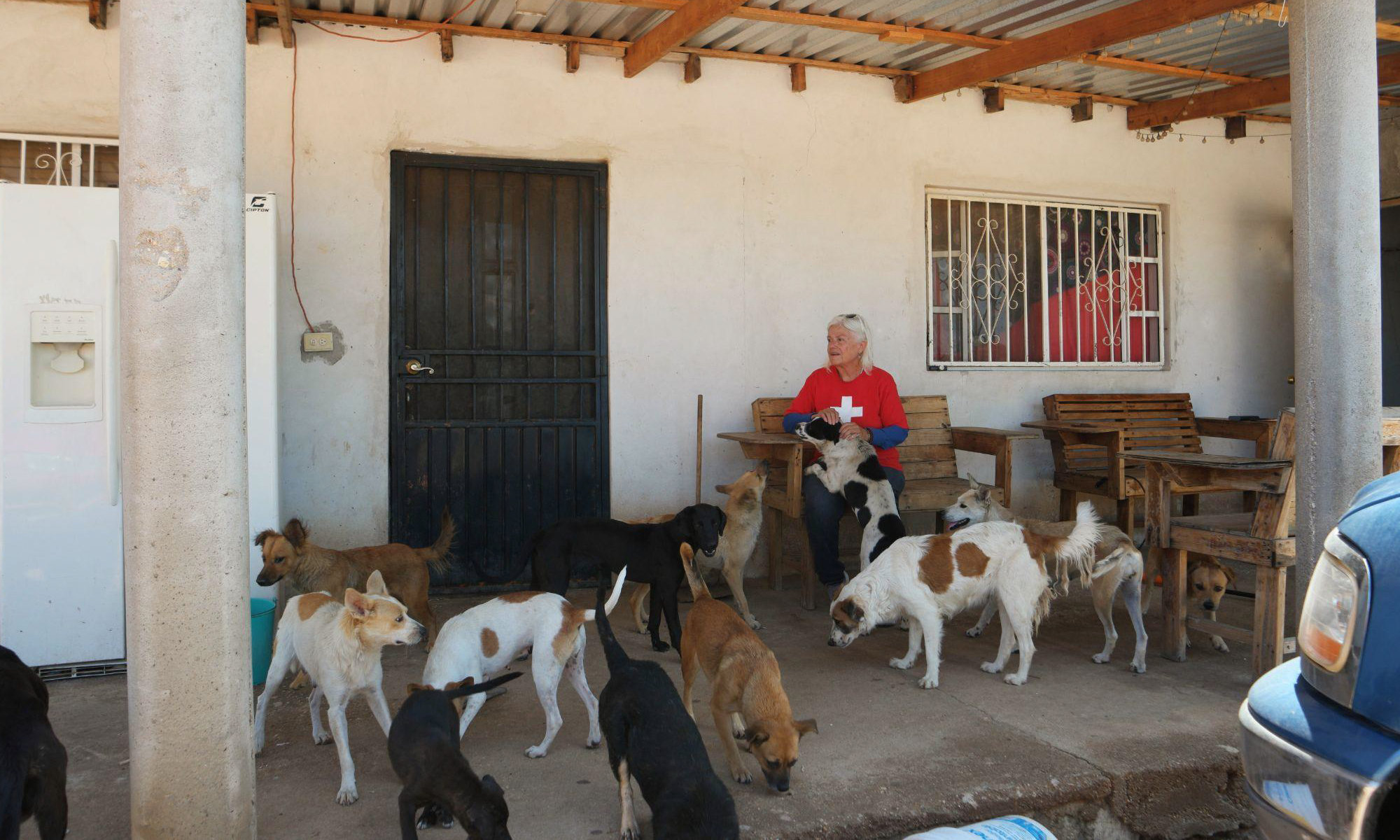
Houses emptied quietly / bowls still filled
Dogs remain / waiting without direction
People left without ceremony / threat unspoken
Care continues / without an audience
Fed by NGOs crossing back and forth / when residents cannot
Migration here is evacuation / not ambition
A town learns to survive / without its people
Avra Valley, Arizona, USA. A known migrant corridor where heat exposure has lead to deaths; Human Borders volunteers place blue water barrels to reduce loss of life.
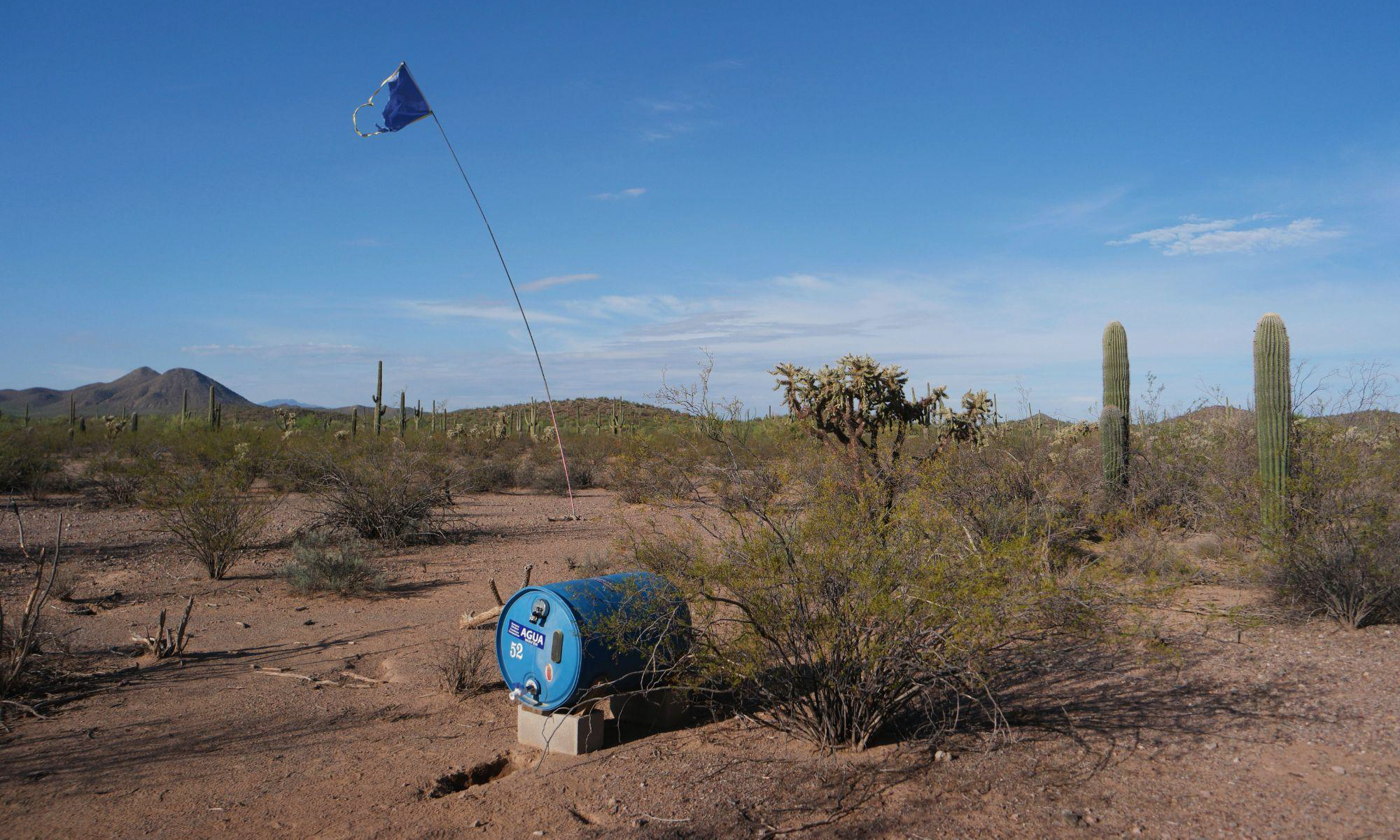
Distance disguises itself as terrain / functions as policy
The Sonoran Desert opens wide / offers no direction
Heat accumulates / walking becomes exposure
Bodies move slowly / under interrupted sky
Water placed deliberately / survival outsources
The barrel waits / without asking who deserves it
Southern Arizona, USA. Camouflage backpacks and discarded clothing.
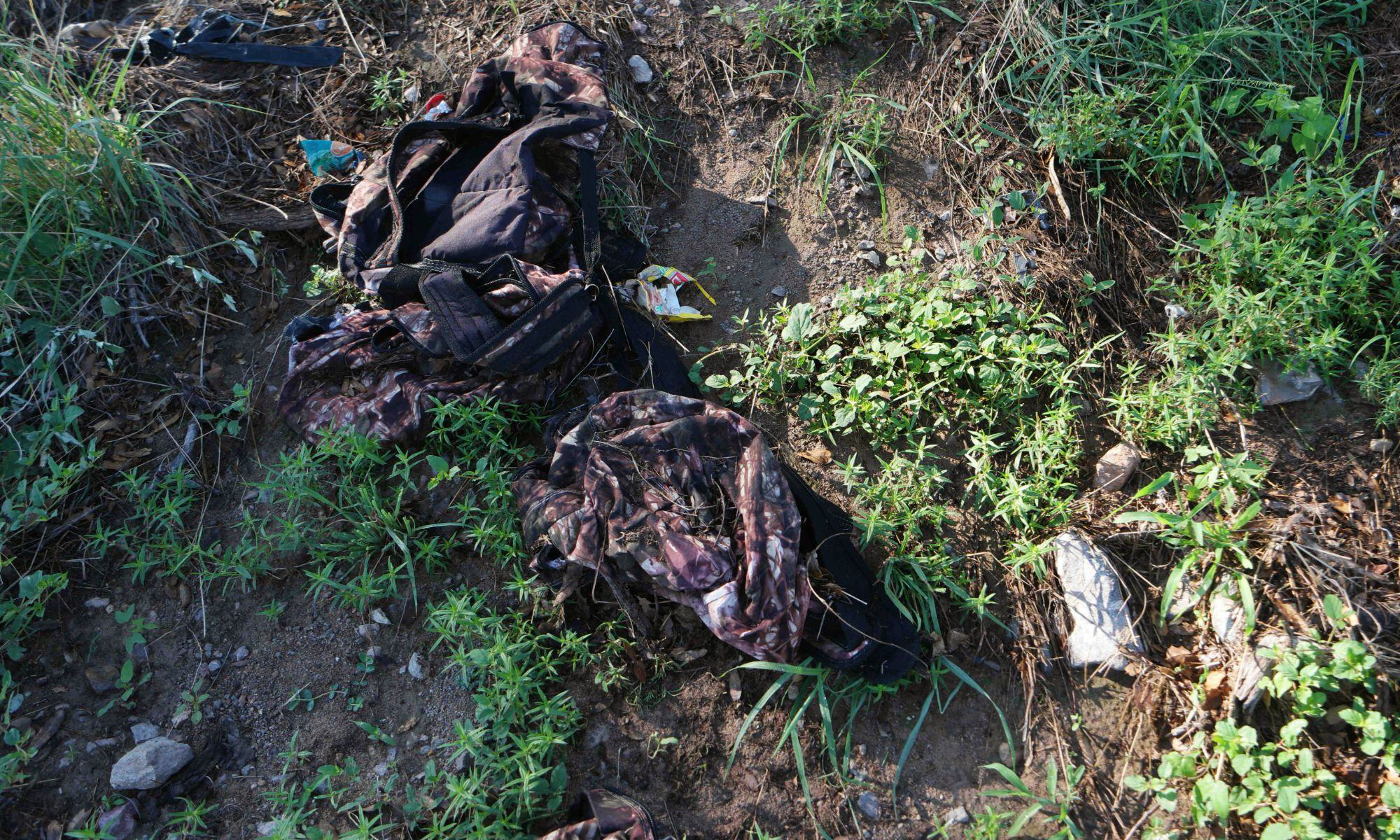
What remains resists classification / artifact or trash
Clothing shed for speed / never retrieved
Belongings loosened from bodies / absorbed by brush
Evidence without a courtroom / stories without witnesses
Nogales, Sonora, Mexico. A black water jug left at the fence, widely recognized as an indicator of an attempted border crossing.
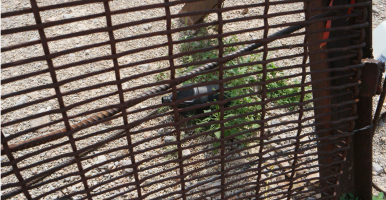
A black jug signals transit / without language
Purchased for distance / abandoned for weight
It marks a body once here / now elsewhere
Arivaca Road, Arizona, USA. A makeshift memorial cross marking a migrant death, part of an often informal tradition along the borderlands where individuals commemorate lives lost on the crossing.
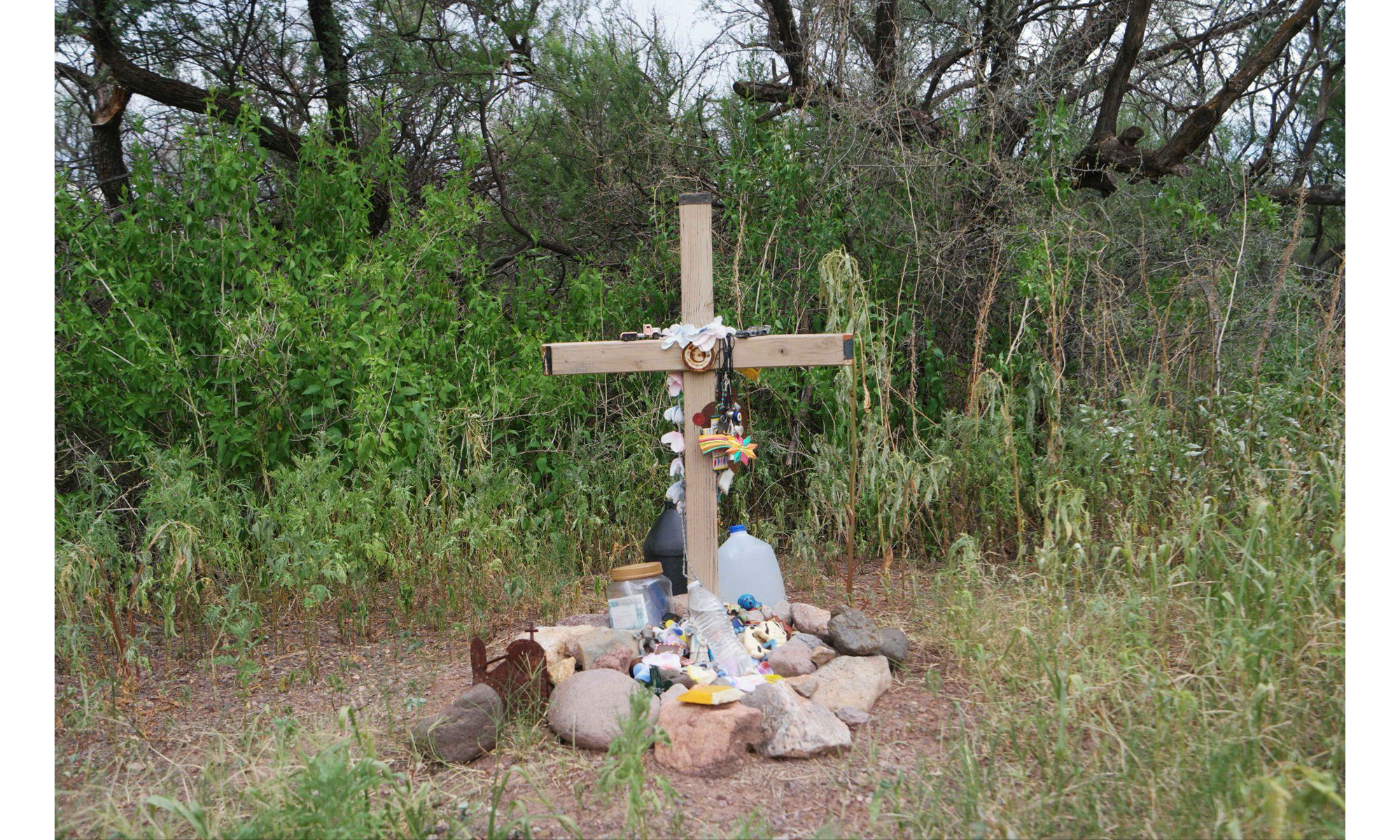
Some are found / some are never named
In the United States, graves remain open
Bodies classified as foreign / pending
The lands keeps records / unevenly
Crosses stand in place of return
Recognition offered / too late
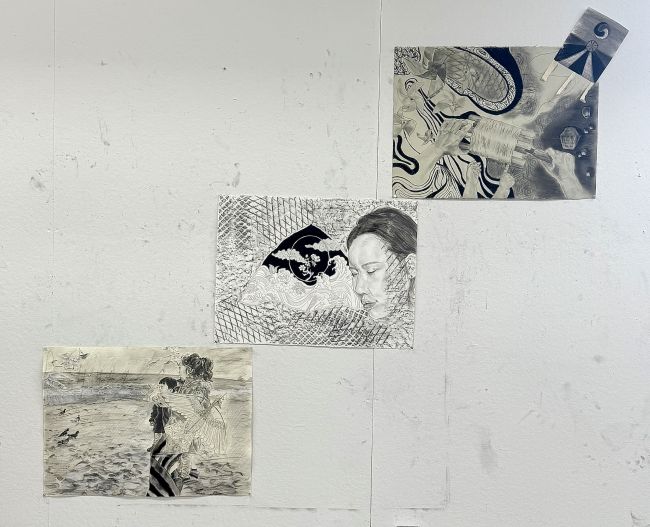
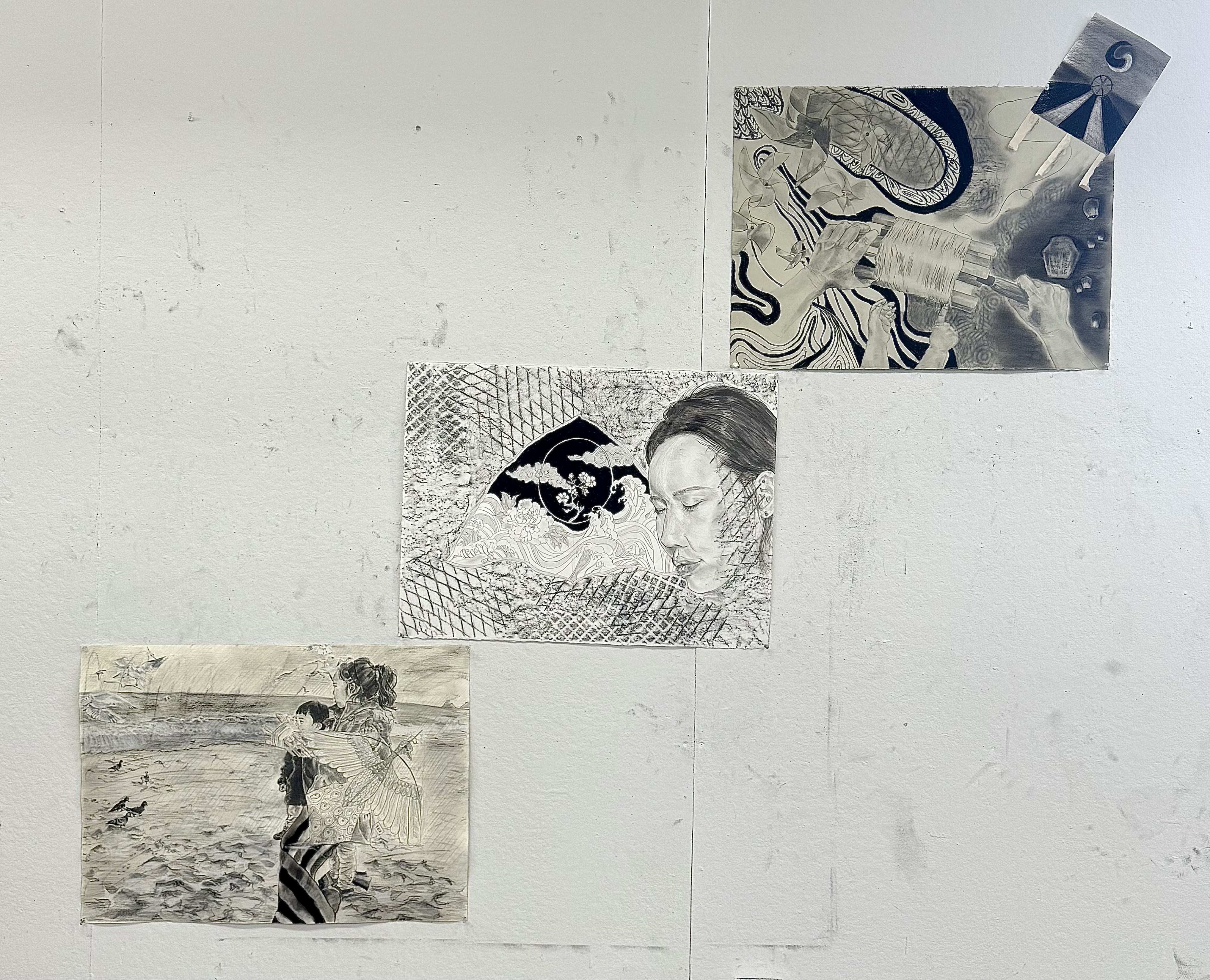
The Kites
By Kylee Lee ’29
Fine Arts, College of Architecture, Art, and Planning
A Tongue with Two Maps
By Aymaan Sheikh, MA ’26
Computer Science, Cornell Bowers Computing and Information Science
In my community, migration turns “home” into a work in progress. It’s built through sacrifices people don’t always talk about, through shared responsibility, through the daily habit of living between cultures. In my કુટુંબ (family), migration wasn’t just a relocation. It changed how we saw ourselves, how we depended on each other, what languages lived in our mouths, and how belonging could exist in more than one place.
I first felt it in kindergarten, in a classroom with fluorescent lights that hummed and made everything look a little too bright. We sat cross-legged in a circle on that rough carpet with the bright primary colors, and the room smelled like glue sticks and dry-erase markers—like every elementary classroom does. I was speaking English normally, answering the teacher and laughing when everyone else laughed, until I looked up and saw another Indian kid across the circle. The classroom stayed put, but my imagination slipped far beyond it. And it was weird how fast it happened. My brain just…switched. BANG, suddenly I could hear peacocks flaunting their vibrant feathers near my parents’ home in Gujrat, sunlight gleaming in a courtyard, and I could hear the faint words relatives talking over each other, children eating ice cream before it melts. The classroom didn’t change, but I felt like I was in two places at once. And without planning it, my mouth shifted too—Urdu and Hindi came out first, like muscle memory, like they’d been waiting right behind my teeth. English didn’t vanish, it was still there, but it moved to the side. That was the first time I understood that migration isn’t only passports and plane tickets. It shows up in your body—how your voice changes without you deciding, how memory can show up under fluorescent lights in a kindergarten circle.
My parents moved from India to the U.S. and basically started over. Those first years were a lot of trial-and-error—new rules, new systems, new expectations they couldn’t have known until they were already living them. My dad worked at Dunkin’ Donuts part-time while working toward a college degree, running on tight sleep and tighter schedules. My mom paused her own education to raise me and my siblings. In our community, that kind of sacrifice isn’t rare—it’s normal: one person’s dream gets put on hold so the whole family can keep going. I’ve seen echoed again and again in migrant families: dreams are rarely discarded; they are delayed, reshaped, and sometimes placed gently into the hands of the next generation like something precious.
In my community, migration changes what “family” looks like. My grandparents moved from India to the United States to help take care of me, not because it was easy, but because that’s what our family needed for my parents to keep working and building stability. In a lot of immigrant households, you don’t really get to be “independent”—everyone carries something. My mom is one of seven siblings and my dad is one of three, so I grew up surrounded by relatives: phone calls across time zones, group chats, weddings and visits that became a big deal because they were rare. Some of my family stayed in India, some moved to different states or different countries, and our relationships stretched with the distance—but they didn’t break. They just changed shape.
Language is where I notice migration the most. At home it was Urdu and Hindi. At Sunday school it was Arabic—letters carefully traced, verses repeated until they felt steady in my mouth. With my grandparents, Gujarati would show up in the middle of everything: greetings, instructions, little jokes. Over time, switching became muscle memory. I learned which language felt right for an elder’s advice and which one fit my friends at school. And I realized you can belong to more than one place without being split in half. Urdu and Hindi keep me close to South Asian culture; Arabic keeps me close to my faith and to a wider Muslim world. In immigrant families, kids don’t just translate sentences—we translate the space between generations.
Faith is another way migration reshapes belonging. Growing up Muslim, the mosque was never only where I prayed. It was where I watched community become action—shoes lined up at the entrance, aunties packing food into containers, volunteers moving quietly so no one feels singled out. Charity—sadaqah—was treated like a responsibility, not a performance. Through outreach, I’ve sat with people dealing with medical bills, job loss, or family stress, and I’ve learned that help doesn’t always look dramatic. Sometimes it’s sitting with someone long enough for them to breathe again. During Ramadan—when meals are shared and donations are gathered for families who need it—I see how migrant communities survive: we learn to build our own safety net, one act at a time.
That same background has given me a role I didn’t apply for but learned to carry: I translate for elders—medical instructions, school forms, appointment calls—turning official language into something human, so the people who built this community with their labor don’t have to face it alone in silence.
Migration also brings a balancing act that can feel complicated. Growing up American in a migrant family meant learning to live between traditions rooted in collective responsibility and a society that often praises individualism. There were times it felt like being bilingual in more than one language, fluent in two sets of rules, two ways of measuring success, two definitions of freedom. Yet over time, that tension became a kind of compass. It taught me adaptability without erasure, confidence without arrogance, and the ability to carry wisdom from both cultures, holding tight to what grounds me while still reaching toward what is possible.
In the end, migration has made my community the kind of place where people turn struggle into unwavering support. The sacrifices aren’t LOUD—they’re in late-night shifts, in dreams paused, in the choices families make every day so nobody falls behind. It’s also created a community that’s scattered across oceans but forever weaved together by language, faith, memory, and care. And it’s shaped me in the middle of all of that: I carry my heritage with me, I feel connected to a wider world (our world), and I’m trying to live in a way that honors what my family gave up to get me here. I’m here because someone went without...I want my life to be living evidence that it wasn’t for nought.
Migrant Life: A Meditation
By Phoenix Wang
PhD Student, Literatures in English, College of Arts and Sciences
Inspired by Emmauele Coccia’s Matemorphoses.
&
Life, do thou hold thyself intact
in thine ordeals of migrating
into discrepant bodies
across time and space?
I. Petal
My avian friend told me that to migrate is to lose your wholeness—something I have never truly understood, every time I tilted my membrane to face the hovering bees.
I saw humans passing back and forth. Their silhouettes dissolved into the nebulous darkness. Sometimes they stopped, signing and sobbing like a child, upon my quivering shadow.
I recalled that in Japanese philosophy, there is a concept called “mono no aware.” Pathos of things. The empathy that channels across bodies.
It was strange to conceive that some humans shed tears upon the imperfection and the impermanence of being. As if in doing so, the tangibility of pain could mediate harm and violence. I relished those moments, nevertheless. It reminded me that in every reluctant flow of my skin, there could be a coherent force: a shimmer that rendered grief as delicate and tangible as my flesh.
Life is always prepared to disintegrate itself in me. Recognizing that fact over the years, I contracted my existence with the moments of waning and ebbing. The eclipse of the moon and the moving backwards of oceanic tides. Thence, my flowering body had gotten accustomed to brokenness.
For innumerable nights, I couldn’t distinguish the wet liquids on my trembling form. Whether they were the tears of human sorrow, or the belated dew. Or both—the artistic pitifulness of Life. And for what? The particles of nature never cease migrating through the thousandth of a light-year.
Indefatigable. At long last, upon a breeze, I fell to the ground.
For an instant, I forgot how to hold a body.
Perchance to lie still. Perchance to be ground into nameless powders. Penchant to relieve from the crumbling skin—a wilting that fumbles forever in the labyrinth of to-flourish.
Beneath the catabasis of the earth, I danced away.
II. Eucalyptus tree
It felt like a cage. Motion without movement.
I looked up, hearing the rustling of the winds from the celestial. Distant and instant at the same moment.
There is a cut in my chasm. Starting from veins and ending with veins of a different color. When I tried to feel the sharp object operating on me, some inner voice mumbled. Life was reluctant to be confined anymore. It craved for flux that none of my kins could substantiate. Self-containment became a reddening eye. Fatigue squeezed its tear out. I held my limb so that foliage could channel the force out.
Out of a strange impulse, there guttered a sense of assuage.
Although I knew, long before its turbulence, that something deeper underneath my root had called the firmament to amble.
And I also understood that one day, after my stillness chanted reveries, I would calmly embrace my fall. Out of the cage. Out of Life.
Before then, I stood there practicing the process of forgetting. Until Life held all its particles out of my reach, I shifted for an attempt to reminisce. Is there something throbbing long before the trunks got named part of a being?
A force tenderer than the odorless nights. I extended my barkskins to let it penetrate.
An indistinct sound of a chainsaw lingered afar.
In cosmic wandering, earlywoods collapsed the Commune of Life.
III. Vulture
I saw through the raven my oblivious kinship. Upon the disbanding of their feathers, words vomited from my belly up to the bark, like rocks dormant in the radiated zone. A broken cacophony—
Carcass. Carnage. Caress.
Caress. Caress. Car…carrr..- e.
I perched on the battlefield, carousing corpses.
Until a gunshot. I realized my body could hardly hold the weight of Life. It struggled to overflow through the trickling blood upon my chest. Through the sores upon the tentacles beneath my feet.
Life yearned to come out. A multitude. I staggered forward to the cliff. Facing the icy dawn, my body flew across the borderlands. Behind my flipping wings, bombs turned ethereal. Muffled by blazing flames, my murmurs detached themselves from my torso.
A scorching heat. Something broke out of my chest over the quarantine zone.
I fell upon the electric lines. A last sight of my vulture self. Integration lighted up the shell-burdened pebble paths.
Life fled me yonder.
IV. Mosses
We crawled into the war cemetery beside the forest. Graves had lost their sheen, making it impossible to differentiate them from weathered stones. Who did they belong to? For whom did they erect? We covered those unformed questions with our unruly greenness.
Something was summoning underneath. As we moved forward, the unnamed surged for a connection.
Every step mapped out an ember. It dwelled on us long ago—that Life had impregnated its traces somewhere below. The flipped remnants of materiality. Yearning for the networks inside our mycelial mesh. An impulse to tangle the losses.
The movements resembled suffocation. Not in the sense of severing existence, but of untethering its finality. So we crept forwards and backwards, up and down. No dots. No trajectories. No fences. No thresholds. Every step ached insofar as it reignited the whimpers of the lost souls deep underneath. Before their beings decomposed, the particles within continued humming. Survival. The word shaped their vestigial wounds into a grotesque monster.
Monstrosity literalizes suffering. We must comprehend that profoundly enough to continue moving. Not as an arboreal hierarchy, but as rhizomes. Let chaos reign. Let voids prance.
Until someday, we embrace the buried moans long dissociated from the graves. Life ultimately reunites.
&
I am still roaming in the celestial, joyfully purposeless at the solitary sight of azure crepuscular glimmers. Is idleness a destined process of Life? Is inevitability an antithesis of being in flow? Planetarily drifting, living and non-living forms never have a home because nothing remains in place. Life pulses forward ceaselessly beyond my transparent wings and misty irises. Someday, they might become broken, monstrous, and fragile. But I am still moving, as if motion itself reminds me of the very reason that I am being here. Am I a ruthless witness to all the vicissitudes? Can I dredge out delicate shimmers and wounded dust out of violence, fury, and resentment? I suppose, one day, my distorted body would merge with the embers of the firmament—and before then, just let myself move in the whirling webs of time. Back and forth, twists and turns. The awkward movements of my limbs, upheld by all my particles and neurons and energies, perpetuate the very meaning of my existence. I am convinced that the weather would remember it long after the disappearance of my physicality. After my traces fade into an empty signifier, a continuity still hovers. What would I tell them? That I was once a body of floating pedals. And once a eucalyptus tree. And once a vulture, feathering astray amid a plethora of decay. And once a patch of moss caressing the tombs of the ungrievable. I murmured to myself that your motion matters all. That one day, after everything gets peeled off their stubborn armors, we embrace our deformities in the breezes—nude, soft, and thorough. And the air of nameless fragrance would keep us company. Once and for all—we reintegrate into the vitality of Life that jots, dissolves, and reassembles itself in an infinity of fervency.