

Emily Apter Returns to Cornell to Explore Translation Justice and the Right to Language
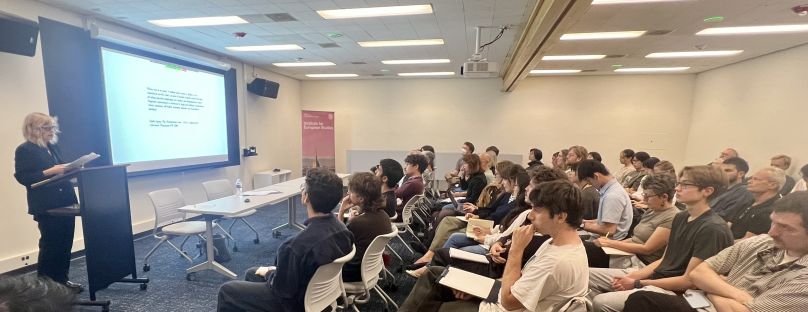
Emily Apter, Julius Silver Professor of French and Comparative Literature at New York University, a renowned scholar whose writings have been shaping Comparative Literature, translation studies, and critical theory for three decades, returned to Cornell to speak on “translation justice” and the “right to language.”
On September 14, Apter lectured to a packed audience in Uris Hall on “Translation and Language Justice in and Beyond Europe.” On September 15, she led a seminar workshop on her forthcoming book, What Is Just Translation?
Taking the replacement of Ukrainian road signs by Russian ones as her point of departure, Apter describes a mode of translational violence that takes the form of imperialistic supplantation of languages. The linguistic proximity or kinship between Russian and Ukrainian, far from making their inter-translation politically inconsequential, turns linguistic difference into a site for asserting dominance: translating (in the sense of replacing) Ukrainian with Russian becomes a “performative of violent territorial sovereignty,” while Russian-speaking Ukrainians’ enrollment in Ukrainian classes becomes an act of resistance. Carl Schmitt’s distinction between friend and enemy can be activated through even the smallest differences in grammar, script, and pronunciation.
In this context, Apter turned to the psychic violence of linguistic usurpation, revisiting the Swiss-born nineteenth-century political thinker Benjamin Constant’s account of Napoleonic conquest. As Constant wrote, “While despotism rules by means of silence, and leaves man the right to be silent; usurpation condemns him to speak,” drawing them into participation in their own violation. These terms from European imperial history remain very much pertinent to our global political present. Language conquest and usurpation are still prevalent today in various, insidious forms, bringing the question of linguistic violence to the policies that regulate which languages can be spoken and recognized.
Apter turned to European language policies, which involve the hierarchization of languages through the strategies of officialization, recognition, and protection. What distinguishes a language that is official from one that is merely recognized or protected, and what inequalities do these distinctions sustain, even where multilingualism is formally affirmed? Apter examined these questions with the examples of Italy’s and Spain’s differential regulation of minority languages, as well as the case of the EU, which affirms linguistic equality and supports multilingualism through extensive translation services, yet relies heavily on Euro-English or Globish. Europe’s multilingual arrangements still manifest unequal rankings amongst languages, in tandem with linguistic uniformization.
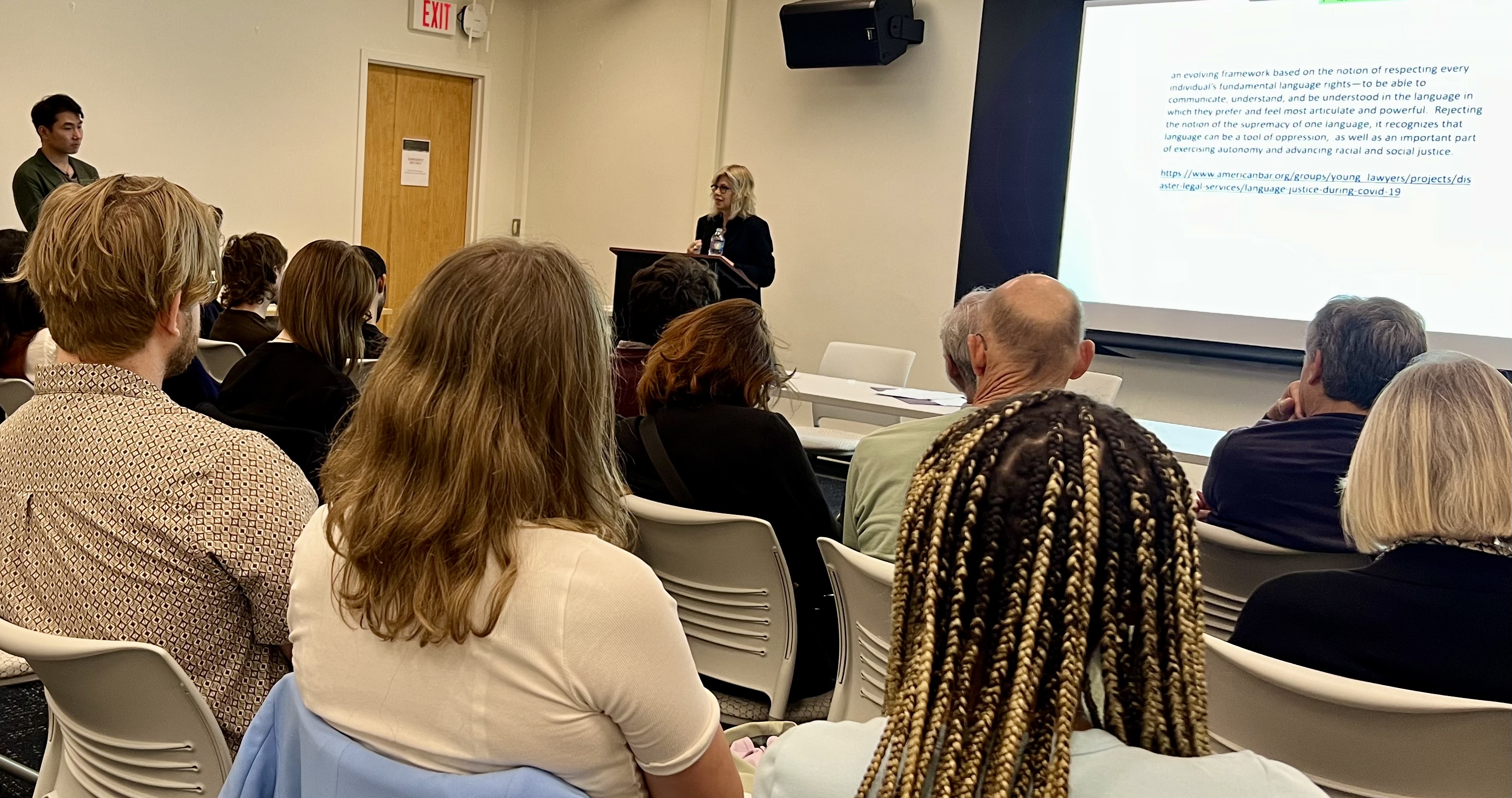
Apter also duly examined the question of language usurpation in the era of AI. Language policies are deeply entangled with what she called “linguistic capitalism.” The promise of “streamlining” in Trump’s English-only policy links technological automation (such as machine translation) to state monolingualization. Apter calls for a defense of linguistic rights against the unquestioned acceptance of an algorithmic lingua franca. Universities’ replacement of human language teaching with AI training, she argues, effectively negates the right to language as well as the right to plurilingual education.
What is at stake is what Apter calls the training of a “plurilingual intelligence” as well as a pursuit of “language dignification”: “the unconditional demand that languages, all languages, be spoken without fear of state reprisal […] the detoxification of linguistic environments haunted by enslavement, vanished tongues and histories of political inequality and language inequality.”
Emily Apter was invited by the Institute for European Studies graduate fellows cohort of 2025–26. Each year, the IES Graduate Fellows collectively invite a speaker whose research addresses “Europe” in the broadest sense: from a geographical, geopolitical, or geocultural radix to the deep and often surprising entanglements between Europe and the world.
Story by Xinyu H. Zhang, IES Graduate Director's Fellow