Representing colleges and schools including A&S, Brooks, Engineering, ILR, and AAP, the 13 students participated in a yearlong cycle of workshops led by faculty mentor Ed Mabaya and Einaudi Center practitioner in residence Paul Kaiser, both world-class experts in international development. The students developed their own research and advocacy projects, working closely with the group's mentors and one another.
Einaudi Spring Showcase
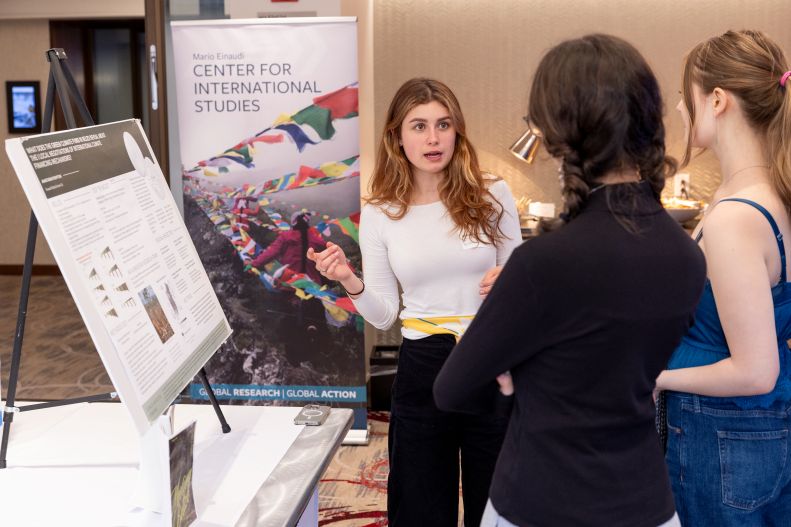
The Global Scholars presented their projects at Einaudi's annual showcase on April 20. The projects highlighted country-specific perspectives on aid, explored new options for the future, and reconsidered the role of the United States in the aid space.

“Aid is only one component of our world order. Many things shape dynamics between countries that should be taken into account. Trade is one of them, a history of colonization and imperialism is one of them. I think we all need to be thinking more critically about our history, our present, and where we're headed.”
~Farah Achouri '27
Bartels World Affairs Lecture
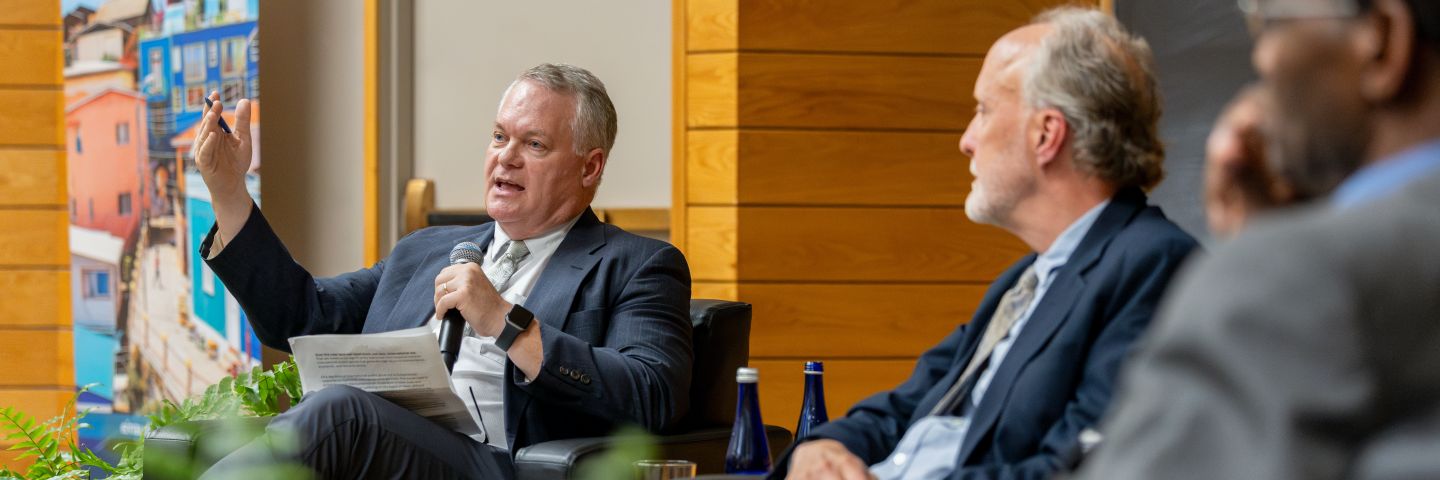
When former USAID administrator Samantha Power visited campus to deliver the Bartels World Affairs Lecture on April 16, the Global Scholars met with her in a small-group session to discuss their projects and future prospects for U.S. foreign aid and engagement abroad. Power responded to several questions from the scholars during the lecture's Q&A.

“The Global Scholars brought a distinct intellectual energy. I sensed an impatience for answers and for evidence of impact, and I love that sensibility. My sense is that you have in this student body people who are going to have a large influence on the trajectory that we are on.”
~Ambassador Samantha Power
Meet the Scholars
Farah Achouri '27, Government and Economics
From Post-Independence to the Fall of USAID: African Perspectives on Development Aid
This project explores how different prominent African thinkers—politicians, economists, academics, and practitioners in the aid field, from the post-independence era until the fall of USAID—have thought about international development aid: whether they found it helpful, obstructive/invasive, whether there was enough or perhaps not the right kind, whether it was obscuring other policies that were in reality harmful, or whether it was a combination of any of these and how their views were shaped by their contexts.
By centering African voices on the matter, I hope to raise awareness within the Cornell community about international aid from an internationalist perspective and to encourage them to seek out marginalized perspectives wherever they are.
Ariela Asllani '26, Public Policy
On the Ground: Ukraine's Hidden Network of Survival
The United States has committed over $175 billion to Ukraine since 2022, making Ukraine the largest recipient of American foreign aid since the Marshall Plan, yet under the current administration no new aid has been authorized since 2024. My exhibition documents the invisible networks of people keeping Ukrainian civilian life intact during one of the harshest winters in recent years. When government-to-government aid withdraws, decentralized human networks absorb the loss. Small groups of ordinary people, most of them unknown beyond their own neighborhoods, were doing what no policy designed and no budget predicted. The story of this war, now in its fourth year of full-scale invasion, is no longer being written in Washington. It is being written by individuals who simply show up. The most resilient form of international aid may not be a program. It may be civil society.
Noah Freedman '26, Government
Rethinking Messaging in the Age of Declining American Aid
I explored what political messaging in American politics is effective in convincing the American electorate that their country should be a prominent supplier of international aid. This question is important because supplying international aid is currently an unpopular foreign policy position among the American electorate.
If those within the international aid community want the United States to be a serious player in the international aid project going forward, it’s vital to understand what messaging will effectively convince the American public that international aid should be given. For my research, I tracked three variables: public support for supplying international aid, party positions on international aid, and changes in the scope of American international aid policy.
Saghyna Ibraev '29, Bioengineering
Evaluating Micro-Renewable Systems for Energy Access in Underserved Rural Regions
This project examines how low-cost, small-scale renewable energy systems can strengthen long-term electrification efforts in off-grid rural communities that international aid agencies often struggle to reach. Many villages, clinics, and schools outside urban centers face unstable or nonexistent electricity, limiting economic activity, education, and healthcare. Despite decades of solar-based aid programs, unreliable weather, high maintenance costs, and short system lifetimes continue to undermine progress. This project explores whether portable micro-hydro, micro-solar, or hybrid systems can offer a more cost-effective, durable alternative.
I chose this project because I am interested in the intersection of engineering, economics, and international development. Growing up across regions with unequal infrastructure shaped my interest in energy access, and I hope to contribute a practical, data-driven tool that helps aid organizations choose technologies that reduce dependency, lower long-term costs, and create more resilient rural communities.
Aayan Kabra '27, Operations Research and Engineering
Aid or Agency: Education, Independence, and Donor Influence in Kenya
This capstone project examines how international education aid shapes the education system in Kenya and whether that support promotes long term independence or creates dependence on outside donors. Education aid provides funding, training, and classroom resources that can expand access to learning and improve outcomes for students. At the same time, aid can introduce donor priorities that influence curriculum decisions, education policy, and national autonomy.
To explore this tension, I combined background research with creative expression. I reviewed existing data and scholarship on education aid flows in Kenya, donor involvement in curriculum and policy, and debates around sustainability and ownership in aid funded education systems. Rather than presenting this research through a traditional paper alone, I translated these themes into an original poem that reflects the lived experience of teachers and students in aid supported classrooms.
Iskander Khan '26, Government
Pakistani Perspectives: External Debt, Economic Challenges, and Sustainable Development
This project examines how debt relief operates both as an economic tool and a political instrument of international aid in the broad sense through a case study of Pakistan, where debt management visibly influences domestic politics and foreign policy and where debt payments constitute half of the national budget. Aside from the U.S., the Russian and Chinese models of debt relief may also be examined to understand the role of debt relief in diplomacy. This paper aims to clarify how debt relief functions as international aid, its political salience in debtor countries, and its strategic consequences.
Tamar Kobakhidze '27, Government
Limited Aid Interventions: Comparative Structures and Lessons for Rural Georgia
Drawing on field research and a comparative literature review of fixed development aid initiatives in developing countries, this project will compare aid frameworks to determine the most effective strategies of distributing “launchpad aid,” or aid that facilitates grassroots initiatives to support local economic development while avoiding aid dependence. Being a form of potential “launchpad aid,” the project examines the extent to which fixed development aid distribution facilitates economic development, as well as asking why fixed development aid produces different results from long-term continuous developmental aid initiatives.
Given my access to rural Georgia, as well as the long cultural and familial connections I have with it, I chose this project because I understand the importance of investing in small rural towns and villages in regions where poverty is highly prevalent. This evaluation of aid tactics aims to consider otherwise disregarded communities in Georgia, allowing us to understand how aid distribution in such areas can function without the issue of dependency."
Jonathan Lam '27, Industrial and Labor Relations
Fifty Years Later: Impacts of Freezing USAID in Southeast Asia
From the 1960s to the 1970s, the United States dropped more than 13 million tons of bombs on Laos, Cambodia, and Vietnam, making the region the most heavily bombed per capita in global history. Millions of cluster munitions failed to detonate, leaving a deadly legacy of unexploded ordnance (UXO) that continues to kill and injure civilians today.
Despite decades of clearance efforts supported by USAID and NGOs, UXO contamination remains extensive. Recent freezes in U.S. assistance have heightened risks, disrupting critical clearance operations and community-based risk-reduction programs. This project examines how aid has shaped UXO mitigation efforts over time, how current freezes impact progress, and how advocacy can strengthen humanitarian responses."
Sarvesh Prabhu '28, Environment and Sustainability
Rethinking International Aid: The Role of National Agricultural Systems
Agriculture research and development (R&D) has been chronically neglected despite its outsized impact on the poorest of the poor: subsistence farmers and fragile local economies. I analyzed the history of aid in India with a focus on agriculture aid, tracking the trajectory from direct food aid programs like Food for Peace and the India Emergency Food Aid (in kind) Act to indirect research and development aid through the establishment of the "Green Revolution" institutions and Indian national institutions.
The central question is this: Can these institutions act as a mechanism for knowledge transfer, creating a beachhead for change that eventually hands over the mantle to local institutions? Or do these international institutions crowd out development and stunt the growth of national systems?
Sophie Rinzler '29, Health Care Policy
Beyond Dependency: Redesigning International Aid for Long-Term Health System Strengthening
Global health aid directs billions of dollars toward improving population health, yet much of this funding is channeled into short-term and disease-specific programs rather than the long-term infrastructure countries need to sustain progress.
My capstone project examines how international aid can be redesigned to strengthen enduring health systems rather than perpetuate dependency in low- and middle-income countries. Focusing on Rwanda and Ghana (two countries with distinct approaches to health governance and donor integration), I explore the structural, financial, and institutional factors that allow some systems to transition toward autonomy while others remain reliant on external support.
Anastasiia Ryshytiuk '28, Urban and Regional Studies
What the Green Climate Fund in Belize Reveals About Local Negotiations of International Climate Financing Mechanisms
What does the Green Climate Fund in Belize reveal about the international mechanisms and local negotiations of developmental aid in the states vulnerable to climate change?
My project examines how the evolving approaches to climate adaptation aid are negotiated at the local institutional and community level in Belize. As a former British colony, a developing country, a debtor to the IMF, and a complex, multiethnic nation, Belize has faced many challenges in international development efforts. Moreover, given the mounting, unavoidable threat of natural disasters increasing in occurrences and magnitudes of a low-lying coastal state, international aid in climate adaptation to Belize is in growing need to substitute the more conventional last-minute emergency relief. Nonetheless, the country is often cited as a pioneer in climate adaptation among other highly vulnerable to climate change coastal nations, making Belize a very important example to study.
Maria Santa '27, Economics and Government
Rethinking "Aid": U.S. Assistance to Puerto Rico and Media Framing
This project analyzes how the United States employs the term “aid” in relation to Puerto Rico as a political image-building tool rather than as an acknowledgement of federal responsibility to its territory. Although Puerto Ricans are U.S. citizens and Puerto Rico is an incorporated territory of the United States, media and government discourse often portray disaster relief efforts, particularly following the events of Hurricane Maria in 2017, as if they were a form of international humanist assistance. This misrepresentation conceals systemic neglect and perpetuates colonial dynamics by depicting the United States as benevolent rather than responsible.
To examine this matter, the project will employ qualitative media discourse analysis, comparative policy review, and conduct interviews with Puerto Rican community members, journalists, and leaders. These methods will detect recurring patterns in news coverage, inconsistencies in federal aid distribution, and firsthand accounts of disaster relief efforts on the island.
Krystlove Yeboah '27, Sociology and Government
Beyond the Metrics: Gender, Aid, and Women's Lives in Ghana
This project examines how international aid shapes the lives of women and gender nonconforming individuals in West Africa by centering voices that are often excluded from policy conversations. I aim to humanize international aid by telling the stories behind development statistics. Growing up in Ghana, I witnessed how uneven access to healthcare, education, and economic resources—often shaped by international aid priorities—impacted my family and community. International aid was never an abstract concept in my life; it shaped my educational opportunities while simultaneously reflecting the broader failures of governmental and development systems to reach rural women. By foregrounding women’s narratives, this project seeks to explore how gender justice can, and must, become central to international aid efforts.